Introduction
Varistors, also known as Metal Oxide Varistors (MOVs), are widely used electronic components designed to protect circuits from voltage surges and transient overvoltage events. Due to their fast response time and high energy absorption capability, varistors play a critical role in ensuring the reliability and safety of modern electronic systems.
In industrial, consumer, and power-related applications, MOV varistors are commonly used as the first line of defense against lightning surges, switching transients, and electrostatic discharge (ESD).
What Is a Varistor?
A varistor is a voltage-dependent resistor whose resistance changes significantly with applied voltage. Under normal operating voltage, a varistor exhibits very high resistance. When the voltage exceeds a specified threshold, its resistance drops sharply, allowing excess energy to be diverted away from sensitive components.
The most common type is the Metal Oxide Varistor (MOV), made primarily from zinc oxide (ZnO) grains combined with other metal oxides.
Working Principle of MOV Varistors
The nonlinear voltage-current (V-I) characteristic of an MOV enables effective surge suppression:
- At normal voltage:
High resistance, minimal leakage current - At surge voltage:
Resistance decreases rapidly, clamping the voltage - After surge:
Returns to high-resistance state
This behavior allows MOV varistors to absorb and dissipate transient energy without affecting normal circuit operation.
In many protection designs, varistors are used together with thermistors and temperature sensors to enhance system reliability and thermal protection.
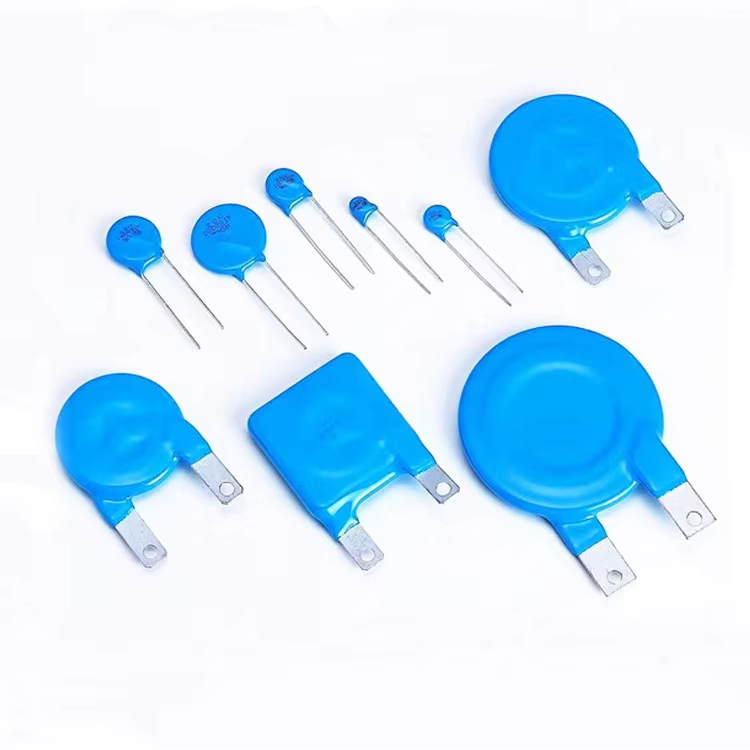
Types of Varistors
1. Disc Varistors
- Commonly used in power supplies and AC line protection
- Available in various diameters for different energy ratings
2. Surface Mount Varistors (SMD)
- Compact size for space-constrained designs
- Suitable for consumer electronics and communication devices
3. High-Energy Varistors
- Designed for industrial and power equipment
- Capable of handling large surge currents
Key Parameters of MOV Varistors
When selecting a varistor, engineers should consider:
- Varistor Voltage (V₁mA)
- Maximum Continuous Operating Voltage (MCOV)
- Surge Current Rating (8/20 μs waveform)
- Energy Absorption Capability (Joules)
- Clamping Voltage
- Response Time
Correct parameter selection ensures optimal surge protection and long service life.
Applications of Varistors
MOV varistors are widely used across various industries, including:
- Power supplies and adapters
- Industrial control systems
- Inverters and motor drives
- LED lighting systems
- Communication equipment
- Consumer electronics
For comprehensive protection, varistors are often combined with other electronic components such as inductors and gas discharge tubes (GDTs) in multi-stage surge protection circuits.
Metal oxide varistors are widely used in surge protection circuits to protect sensitive electronic components from transient overvoltage events.
Varistors vs Gas Discharge Tubes (GDT)
| Feature | Varistor (MOV) | Gas Discharge Tube (GDT) |
|---|---|---|
| Response Time | Fast | Slower |
| Clamping Accuracy | Moderate | High after breakdown |
| Energy Handling | Medium | Very High |
| Typical Use | Secondary protection | Primary lightning protection |
In many designs, MOVs and GDTs are used together to achieve optimal protection performance.
Conclusion
Varistors (MOVs) are essential surge protection components that help safeguard electronic systems against voltage transients and electrical disturbances. By selecting the appropriate varistor type and parameters, engineers can significantly improve system reliability and operational safety.
As part of a complete electronic components solution, MOV varistors remain a cost-effective and reliable choice for surge suppression in modern electronics.