
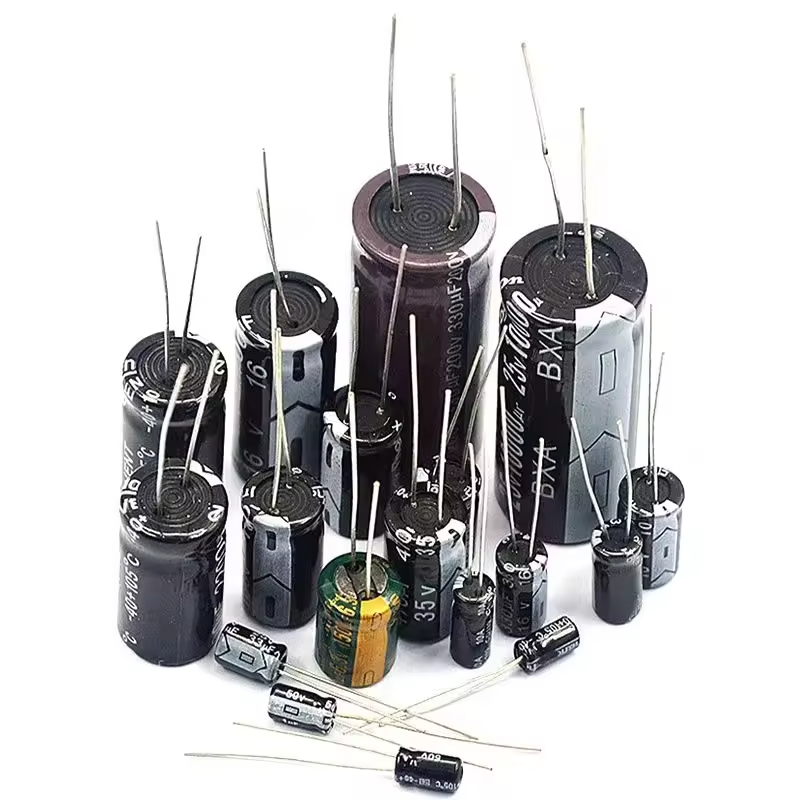
Capacitors are fundamental electronic components used to store and release electrical energy in electronic circuits. Together with resistors and inductors, capacitors form the basic building blocks of modern electronic systems, enabling stable power delivery, signal filtering, and energy management.
What Is a Capacitor?
A capacitor is a passive electronic component that stores electrical energy in an electric field between two conductive plates separated by a dielectric material. When voltage is applied, the capacitor accumulates charge and releases it when required by the circuit.
Capacitors are widely used for smoothing voltage fluctuations, blocking DC signals, coupling AC signals, and improving overall circuit stability.
Main Types of Capacitors
Capacitors can be classified based on dielectric material, structure, and application requirements.
1. Ceramic Capacitors
Ceramic capacitors are compact, non-polarized components commonly used for decoupling, bypassing, and high-frequency signal applications. They offer good stability and low loss.
2. Electrolytic Capacitors
Electrolytic capacitors provide high capacitance values and are typically used in power supply filtering and bulk energy storage. They are polarized and require correct installation.
3. Film Capacitors
Film capacitors are known for their stability, low ESR, and long service life. They are widely used in signal processing, industrial control, and power electronics.
4. Tantalum Capacitors
Tantalum capacitors offer high capacitance in a small package and are commonly used in compact electronic devices where space is limited.
Key Applications of Capacitors
Capacitors play an essential role in various electronic applications, including:
- Power supply filtering and voltage smoothing
- Signal coupling and decoupling
- Noise suppression and EMI reduction
- Timing and oscillation circuits
- Energy storage in power electronics
In many power and control systems, capacitors work together with inductors to form LC or LC filter circuits for efficient power conversion.
Capacitors can also support surge protection circuits by filtering high-frequency noise.
Capacitors in IC-Based Systems
Modern electronic designs rely heavily on IC chips, which require stable and clean power supplies to operate reliably. Capacitors are placed close to IC chips to provide decoupling, reduce voltage ripple, and suppress transient noise.
Without proper capacitor selection and placement, IC performance and system reliability can be significantly affected.
Capacitors and Circuit Protection
In surge protection and industrial environments, capacitors are often used alongside protection components such as metal oxide varistors (MOV) and gas discharge tubes (GDT). These components help protect circuits from voltage spikes, transients, and electromagnetic interference.
How to Choose the Right Capacitor
When selecting capacitors for electronic designs, key factors to consider include:
- Capacitance value and tolerance
- Rated voltage and temperature range
- Dielectric type and ESR characteristics
- Application environment and reliability requirements
Choosing the right capacitor ensures long-term performance, safety, and compatibility with other electronic components.
Conclusion
Capacitors are indispensable electronic components that support stable power delivery, signal integrity, and reliable system operation. By selecting appropriate capacitor types and combining them with IC chips, inductors, and protection devices, designers can build efficient and durable electronic systems for industrial, commercial, and OEM applications.