
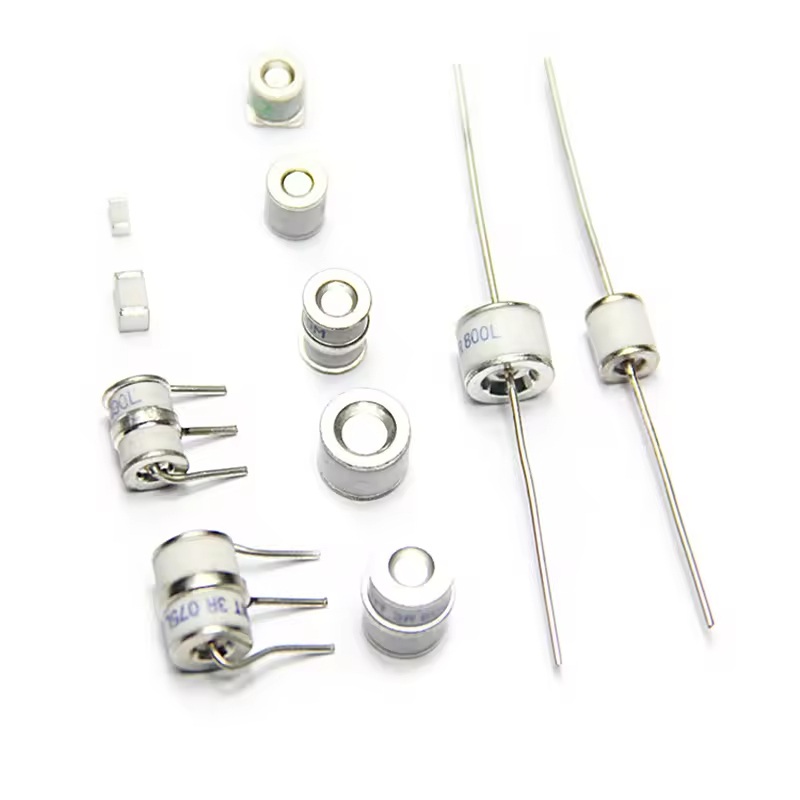
How Gas Discharge Tubes Protect Electronic Circuits from Surge Damage
Gas Discharge Tubes (GDTs) are widely used surge protection components designed to protect electronic circuits from high-energy transient overvoltage events such as lightning strikes and switching surges.
What Is a Gas Discharge Tube (GDT)?
A Gas Discharge Tube is a voltage-dependent device filled with inert gas and sealed between two or three electrodes. Under normal operating conditions, the GDT remains in a high-impedance state and does not affect circuit operation.
When a surge voltage exceeds the breakdown threshold, the gas inside the tube ionizes rapidly, creating a low-impedance path that diverts excess energy away from sensitive electronic components.
How GDTs Work in Surge Protection Circuits
The operating principle of a GDT can be summarized in three stages:
- Normal Operation
The GDT remains inactive with minimal leakage current. - Surge Event
When a high-voltage transient occurs, the gas ionizes and the GDT switches to a conductive state within microseconds. - Energy Dissipation and Recovery
After the surge event ends, the GDT returns to its high-impedance state, restoring normal circuit operation.
This fast response and high surge current capability make GDTs ideal for lightning and surge protection applications.
Typical Applications of Gas Discharge Tubes
Gas Discharge Tubes are commonly used in:
- Surge Protective Devices (SPD)
- Power supply systems
- Telecommunication equipment
- Industrial control electronics
- Outdoor and lightning-exposed electronic installations
GDTs vs Other Surge Protection Components
Compared to MOVs and TVS diodes, GDTs offer:
- Higher surge current handling capability
- Lower capacitance
- Longer service life under repeated surge conditions
Gas Discharge Tubes often work with varistors (MOVs) in multi-stage surge protection circuits to handle both low-level and high-energy transients
In many designs, surge protection using GDTs and MOVs is paired with energy storage and filtering components such as inductors for better overall circuit stability.
Gas discharge tubes are commonly used in surge protection systems to safely divert high surge currents away from sensitive electronic circuits.
Choosing the Right GDT for Your Application
Key parameters to consider when selecting a GDT include breakdown voltage, impulse discharge current, response time, and electrode configuration. Selecting the appropriate GDT helps ensure reliable protection and long-term system stability.
As part of our Electronic Components portfolio, Gas Discharge Tubes play an essential role in protecting electronic systems from surge-related damage.