
Introduction
Inductors are fundamental electronic components widely used in electronic circuits for energy storage, filtering, and noise suppression. From power supplies and converters to communication and automotive electronics, inductors play a critical role in maintaining stable and efficient circuit performance.
With the increasing demand for compact and high-efficiency electronic systems, understanding inductor types, working principles, and application considerations has become essential for modern circuit design.
What Is an Inductor?
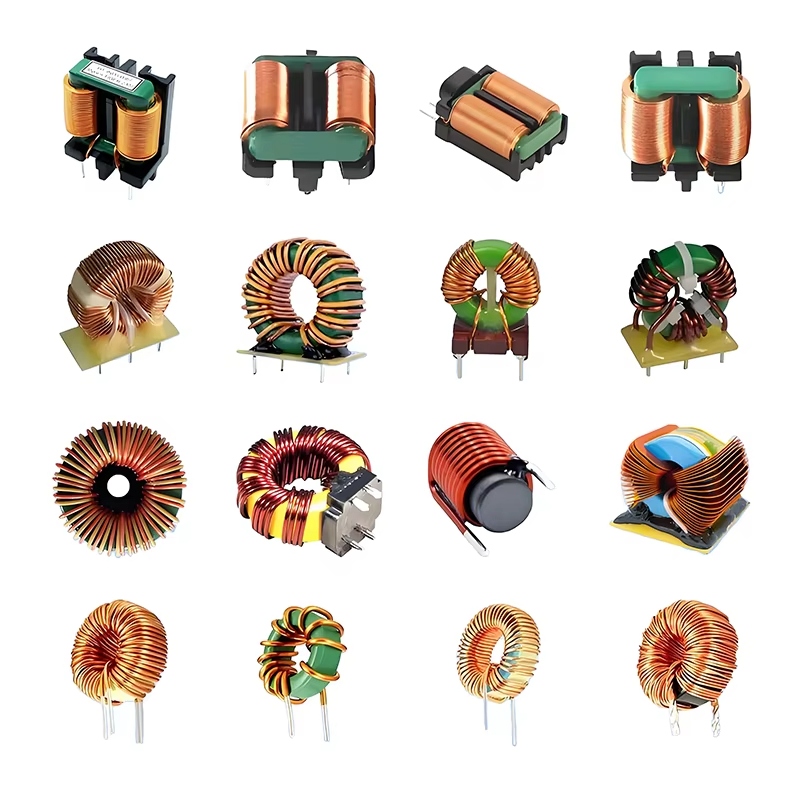
An inductor is a passive electronic component that stores energy in the form of a magnetic field when electric current flows through it. It typically consists of a coil of wire wound around a core material such as air, ferrite, or iron powder.
Inductors resist changes in current, making them ideal for applications involving filtering, energy transfer, and electromagnetic interference (EMI) suppression.
Working Principle of Inductors
The operating principle of an inductor is based on electromagnetic induction:
- When current flows through the coil, a magnetic field is generated.
- Any change in current induces a voltage that opposes the change (Lenz’s Law).
- Energy is stored in the magnetic field and released when the current decreases.
In power and protection circuits, inductors are often used together with varistors (MOVs) and gas discharge tubes (GDTs) to improve overall system stability and surge resistance.
In many power and filtering applications, inductors are commonly used together with capacitors to form LC circuits for voltage regulation, noise suppression, and energy storage.
Types of Inductors
1. Air Core Inductors
- No magnetic core material
- Low core loss and high linearity
- Used in RF and high-frequency applications
2. Ferrite Core Inductors
- High magnetic permeability
- Compact size with high inductance
- Common in power supplies and EMI filters
3. Iron Powder Inductors
- High saturation current
- Suitable for DC-DC converters and power inductors
4. SMD Inductors
- Small footprint for surface mount applications
- Widely used in consumer electronics and communication devices
Key Parameters of Inductors
When selecting an inductor, the following parameters are critical:
- Inductance value (µH / mH)
- Rated current
- Saturation current
- DC resistance (DCR)
- Core material
- Operating frequency
Proper parameter selection ensures optimal performance and long-term reliability.
Applications of Inductors
Inductors are used in a wide range of applications, including:
- DC-DC converters and switching power supplies
- EMI and noise filtering circuits
- Signal processing and RF circuits
- Inverters and motor drives
- LED drivers and power control modules
In temperature-sensitive environments, inductors may be paired with temperature sensors and thermistors to monitor thermal conditions and prevent overheating.
Inductors vs Capacitors
| Feature | Inductor | Capacitor |
|---|---|---|
| Energy Storage | Magnetic Field | Electric Field |
| Response to DC | Passes DC | Blocks DC |
| Typical Use | Filtering, energy transfer | Smoothing, decoupling |
Inductors and capacitors are often used together to form LC filters in power and signal conditioning circuits.
Conclusion
Inductors are indispensable components in modern electronic systems, offering efficient energy storage, current regulation, and noise suppression. By understanding inductor principles, types, and selection criteria, engineers can design reliable and high-performance circuits for industrial and consumer applications.
As part of a complete electronic components solution, inductors continue to play a vital role in ensuring system efficiency and stability.