
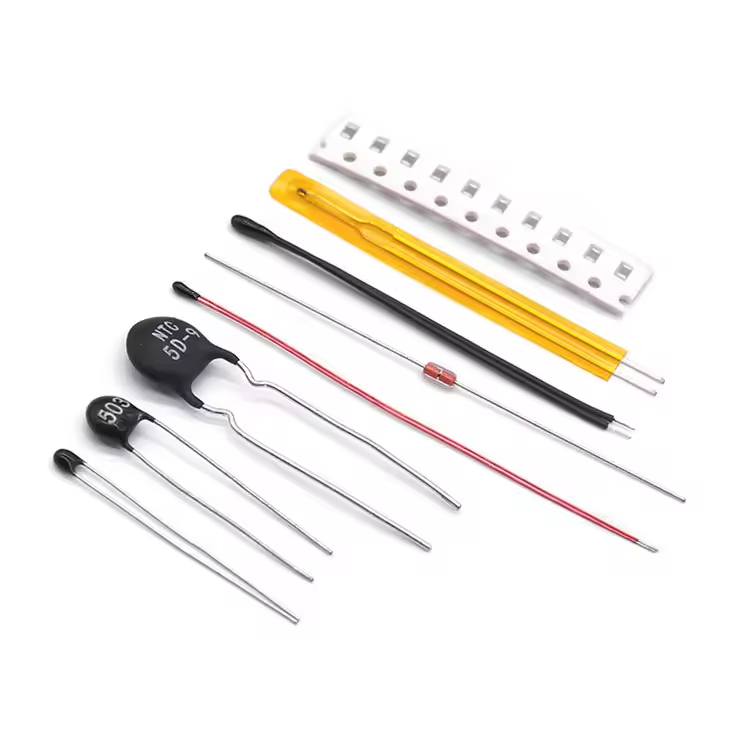
What Is a Thermistor?
A thermistor is a type of temperature-sensitive resistor whose resistance changes significantly with temperature. Compared with standard resistors, thermistors offer much higher sensitivity, making them ideal for temperature measurement, monitoring, and compensation applications.
Thermistors are widely used in consumer electronics, power supplies, industrial control systems, automotive electronics, and medical devices.
Types of Thermistors
Thermistors are generally classified into two main types:
1. NTC Thermistors (Negative Temperature Coefficient)
- Resistance decreases as temperature rises
- Most commonly used type
- Applications: temperature sensing, inrush current limiting, battery protection
2. PTC Thermistors (Positive Temperature Coefficient)
- Resistance increases sharply after reaching a specific temperature
- Applications: overcurrent protection, self-resetting fuses, motor protection
How Does a Thermistor Work?
Thermistors are made from semiconductor ceramic materials. When temperature changes, the number of charge carriers inside the material changes, causing a significant variation in resistance.
This strong resistance-temperature relationship allows thermistors to:
- Detect small temperature changes
- Provide fast response times
- Deliver accurate temperature control when paired with electronic circuits
Key Advantages of Thermistors
- High temperature sensitivity
- Fast response time
- Compact size
- Cost-effective compared to RTDs and thermocouples
- Wide resistance range options
Typical Applications
Thermistors are commonly used in:
- Power adapters and SMPS circuits
- Battery packs and BMS systems
- Home appliances (air conditioners, refrigerators)
- Automotive temperature monitoring
- Industrial temperature control systems
- Thermistors are often used together with temperature sensors for accurate monitoring and control in industrial and consumer electronics applications.
For a complete range of industrial electronic components, please visit our
Electronic Components product category:
Thermistors vs Temperature Sensors
| Feature | Thermistor | RTD | Thermocouple |
|---|---|---|---|
| Accuracy | High (narrow range) | Very High | Medium |
| Response Time | Fast | Medium | Fast |
| Cost | Low | High | Medium |
| Temperature Range | Limited | Medium | Wide |
Thermistors are best suited for applications requiring high accuracy within a limited temperature range.
Choosing the Right Thermistor
When selecting a thermistor, consider:
- Resistance value at 25°C (R25)
- B-value (temperature coefficient)
- Operating temperature range
- Package type (radial, axial, SMD)
- Application environment
Conclusion
Thermistors play a crucial role in modern electronic designs where accurate and reliable temperature sensing is required. With the right selection, they can significantly improve system performance, safety, and longevity.
In addition to thermistors, other protection-related electronic components such as varistors and gas discharge tubes are widely used in surge and overvoltage protection circuits.
If you are looking for customized thermistor solutions or technical support, feel free to contact our team.